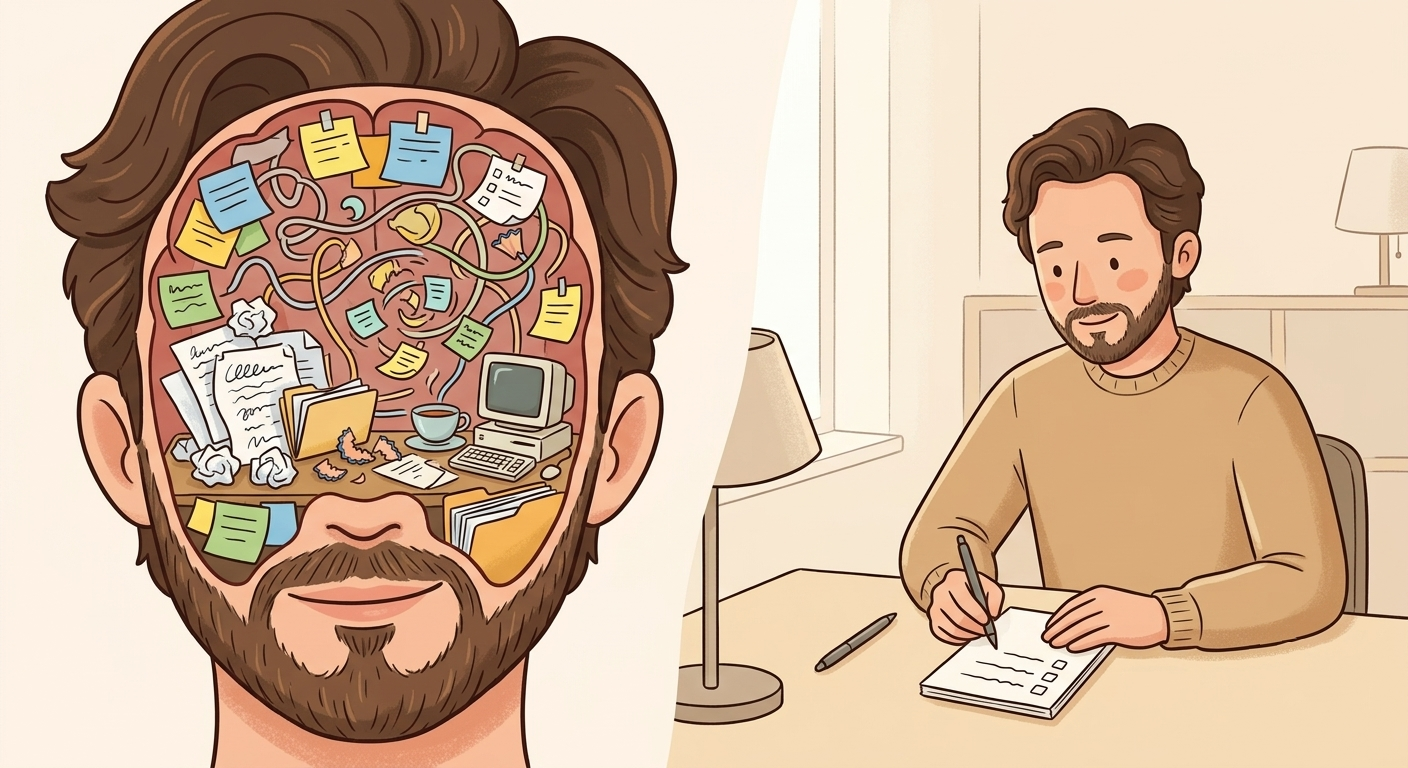
If your brain were a physical desk, most days it would probably look illegal under basic health and safety rules.
Random sticky notes.
Old projects.
Three copies of the same worry.
And in the middle, a tiny space where you are supposed to think clearly.
This is what happens when we treat our mind like an infinite to‑do app instead of a limited, living system.
The mind as a confused project manager
Your mind tries to be helpful.
It collects:
- things you promised to do,
- things you might want to do,
- things other people think you should do,
- plus a few unresolved arguments from 2013.
Then it tries to manage all of this by:
- repeating reminders at 2:37 in the morning,
- throwing images of emails you forgot to answer,
- replaying conversations you wish went differently.
If this were a project manager, you would probably send them on holiday.
But because it’s “just your brain”, you call it being responsible.
Why your brain makes a terrible task app
Good task apps:
- store items outside your head,
- let you sort and prioritise,
- show only a few things at a time,
- can be switched off.
Your brain does the opposite:
- it keeps everything inside,
- mixes tasks with fears, hopes and old memories,
- shows you the worst items at random,
- refuses to switch off when you absolutely need sleep.
It is not broken.
It was simply not designed to run a 24/7 productivity startup.
The guilt loop
When your brain fails as a perfect organiser, you might think:
- “I am lazy.”
- “I am disorganised.”
- “Other people manage, what’s wrong with me?”
So you respond with more:
- pushing,
- multitasking,
- new systems and apps,
- self‑criticism.
Psychologically, this is a neat little loop:
- Expect your brain to be a machine.
- Blame yourself when it isn’t.
- Use blame as motivation to push harder.
- Overload the system even more.
At no point do we ask the obvious question:
“Maybe my brain is not a to‑do list?”
Three small experiments to give your mind a different job
You don’t need a life overhaul.
You need a slightly different contract with your own head.
1. The two‑minute brain dump
Once a day, set a timer for two minutes.
Write down everything your mind throws at you:
- tasks,
- half‑ideas,
- worries,
- “don’t forget…” notes.
When the timer rings, stop.
Look at the list and say:
“Thank you, brain. Your job is to notice.
Sorting is my job, not yours.”
Then move 1–3 items to a real system (calendar, app, notebook).
The rest can wait.
Your brain learns: it doesn’t have to hold everything alone.
2. The “three things today” rule
In the morning, decide:
- one thing that would make today feel meaningful,
- one thing that keeps life running (admin, chores),
- one thing just for you.
That’s it: three priorities.
Everything else is optional bonus.
If your brain tries to add ten more, you can answer:
“Thank you for your enthusiasm.
Today we are a human, not a robot.”
3. The evening “I did” list
Most people go to bed scrolling through a mental list called “not done”.
Try this for one week:
- each evening, write three things you actually did,
- they can be small: answered a message, went for a walk, rested when you were tired.
This is not fake positivity.
To your nervous system, it is information:
“Some things are moving. I am not permanently stuck.”
Over time, your inner narrator becomes less of a harsh auditor
and more of a slightly kinder witness.
The point is not perfect organisation
You will still forget things.
You will still have messy days.
Your brain will still occasionally replay an awkward moment from years ago for no reason.
But if you stop treating it like a failing productivity app,
you might notice something softer underneath:
- a system that is trying hard to protect you,
- a mind that works better with fewer inputs,
- a life that feels less like an endless error report.
You are allowed to be a person with a notebook and a calendar,
not a walking to‑do list pretending to be a machine.


Michael Mentes
attention Biology Chaos Chemistry Coffee Cognitive bias Coincidences Complex systems consciousness Conservation of energy Energy Everyday life Felix Schröder Friction Humour ideas life love mental-health Michael Mentes Mind & Psychology mindfulness Models of reality Navigation Objectivity Patterns Perception philosophy Physics Planning Probability Productivity Psychology reflection science Self-compassion Self-worth Signals Stress Systems thinking technology Time Work and heat Workplaces writing
Leave a Reply