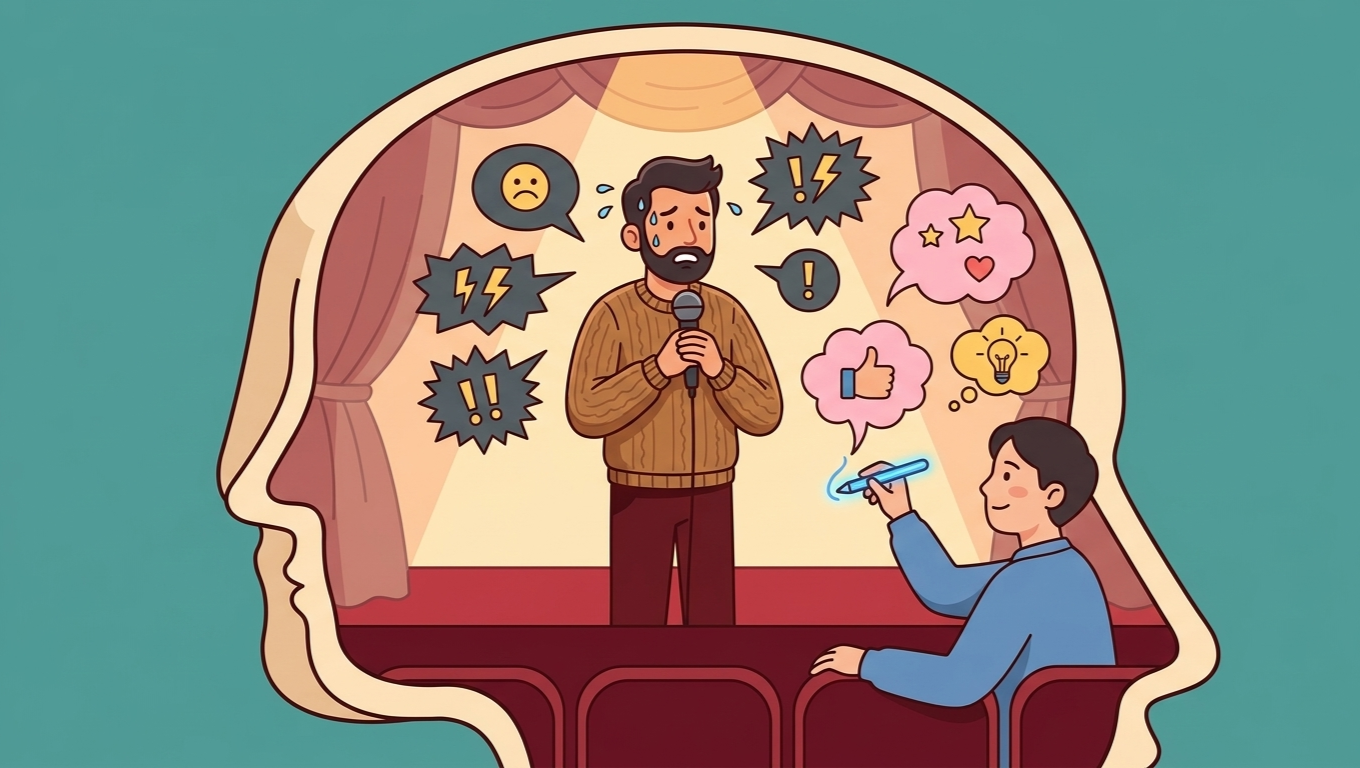
If you recorded everything your inner critic says in a week and played it back like a podcast, chances are you wouldn’t rate it five stars.
It repeats the same jokes.
It misreads the room.
It thinks being rude is the same as being honest.
And yet you keep giving it the microphone.
This is not a clinical diagnosis.
This is me, Michael, gently suggesting that your harshest thoughts about yourself are less a voice of truth and more a very nervous comedian who forgot how to be funny.
Meet your inner stand‑up
Imagine your inner critic as a person on a small stage in your mind.
The spotlight turns on and he starts:
- “That was not good enough.”
- “Everyone will notice you messed up.”
- “You should have figured this out years ago.”
No one in the audience laughs.
No one claps.
But the critic assumes silence means agreement.
From a psychological point of view, this critic is built from:
- old messages you heard about success and failure,
- moments when you were judged or compared,
- your own habit of expecting perfection from yourself.
From a human point of view, he is simply bad at his job.
Why you keep him on stage
If the critic is so unpleasant, why do we let him stay?
Because he promises three things:
- Protection.
“If I attack you first, others won’t hurt you as much.” - Motivation.
“If I make you feel guilty, you will try harder.” - Control.
“If I point out every possible mistake, we will be safe.”
The logic is understandable.
The results are usually the opposite:
- constant self‑attack makes you more sensitive to external criticism,
- guilt burns energy instead of creating it,
- seeing only mistakes makes the world feel more dangerous, not safer.
Your inner critic wants to help.
He just chose a strange professional path.
The problem with one‑star reviews from inside your head
Imagine a restaurant where the owner writes all the reviews himself:
- “Terrible food.”
- “Service was slow.”
- “The chef should change careers.”
Eventually, customers stop coming.
Not because the restaurant is truly awful,
but because the only visible story about it is written by someone who is never satisfied.
Your inner critic does something similar:
- it writes one‑star reviews about your work, relationships, body, future,
- it publishes them directly in your attention feed,
- and you rarely check whether anyone outside your head would agree.
Psychology has a word for this: negative bias.
The brain is simply better at noticing problems than positives.
But when the critic takes over the microphone, that bias stops being a useful survival tool and becomes background noise.
You don’t have to fire him, but you can rewrite his job
Here is the good news:
you don’t have to remove your inner critic completely.
Some part of you that can spot risks and mistakes is useful.
It helps you grow, learn, avoid repeating the same painful patterns.
What you can change is his role:
- from “aggressive stand‑up who insults the audience”,
- to “occasionally helpful editor who points out one or two things to improve”.
That shift does not require a personality transplant.
It requires new rules for the stage.
Three new rules for your inner microphone
Try these as an experiment, not a law:
1. The “evidence, please” rule
Every time the critic says something absolute, like:
- “You’re always failing.”
- “Nobody likes you.”
ask gently:
“Can you show me five real examples from the last month?”
If he can’t, he has to rephrase:
- “I felt like I failed today.”
- “I worry that people don’t like me in this situation.”
Suddenly the joke is less cruel and more honest.
And honest sentences are easier to work with than dramatic ones.
2. The “talk to a friend” rule
Before you accept what the critic says, translate it into a sentence you would say to a close friend in the same situation.
If the sentence sounds ridiculous or cruel, you have just discovered that your critic uses a special, unhelpful language only for you.
Then rewrite:
- “You’re useless” becomes “You’re tired and frustrated. Let’s see what went wrong.”
- “You always ruin things” becomes “This mattered to you and it didn’t go how you hoped.”
Same situation.
Different tone.
Your nervous comedian becomes a more human storyteller.
3. The “stage time limit” rule
Decide when the critic is allowed on stage.
For example:
- ten minutes at the end of a workday to honestly review what you did,
- not during first drafts, new experiences or moments when you need courage.
Outside those agreed slots, you treat his comments as background noise, not as the main show.
You don’t have to argue with every line.
You can simply say:
“Not your time. I’m writing. We’ll talk later.”
The point of all this
None of this is about becoming perfectly confident or silencing every uncomfortable thought.
It is about remembering that:
your inner critic is not the only voice available,
and being harsh does not automatically make it right.
When you stop treating him as a prophet and start seeing him as a slightly anxious comic who learned his material in difficult rooms, you gain space:
- to invite other voices in (curiosity, compassion, calm analysis),
- to try things without expecting a brutal review,
- to build a life that is guided by more than fear of imperfection.
I am not here to delete your critic.
I am here to help you give him better scripts and smaller stages,
so the rest of you can finally have more time at the microphone.


Michael Mentes
attention Biology Chaos Chemistry Coffee Cognitive bias Coincidences Complex systems consciousness Conservation of energy Energy Everyday life Felix Schröder Friction Humour ideas life love mental-health Michael Mentes Mind & Psychology mindfulness Models of reality Navigation Objectivity Patterns Perception philosophy Physics Planning Probability Productivity Psychology reflection science Self-compassion Self-worth Signals Stress Systems thinking technology Time Work and heat Workplaces writing
Leave a Reply